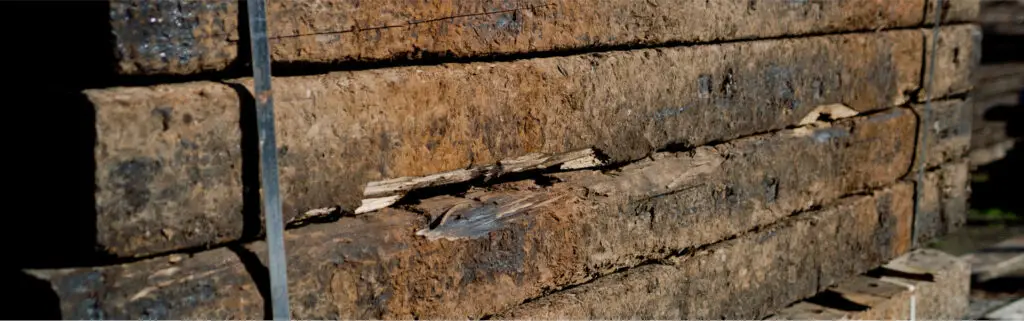
Railway sleepers have been a cornerstone of New Zealand landscaping for decades — used in retaining walls, garden edging, steps, planter boxes and outdoor structures. But not all sleepers are the same. The material a sleeper is made from determines its durability, workability, cost and ideal application. Below: the four main sleeper materials — timber, concrete, steel and plastic — compared for NZ conditions.
Railway sleepers, or, railroad ties, are an essential component of railway tracks. They provide support for the rails and help maintain the correct ‘gauge’ or space between the two rails.
Traditionally, railway sleepers have been made from wood, but over the years, other materials such as concrete, steel, and plastic have also been used depending on the rail-application and location of the track.
Wooden Sleepers
The most common type of railway sleeper, especially in historical contexts, are wooden sleepers. These are typically made from hardwoods like oak, jarrah, and Ironwood, but also here in New Zealand in a contemporary context they have been made from (preservation treated) Pinus Radiata, a softwood.
In the late 1860s and early 1900s New Zealand railways primarily used native hardwoods such as Rimu, Tōtara, and Mataī when the South Island rail network was first being established. These timbers were chosen for their strength and resistance to decay, as well as easy accessibility. However, as railway expansion increased, the demand for sleepers outstripped the available supply of native timbers.
By the early 1900s New Zealand then began importing Australian hardwoods, particularly Jarrah. This timber was durable and provided a reliable service life. However, after World War II, the quality of Jarrah declined, as second-growth stands replaced the high-quality virgin timber previously supplied. This led to sleepers failing prematurely due to checking, splitting, and decay.

Hardwoods are still chosen for their durability and resistance to wear and tear. Some wooden sleepers are treated with preservatives to protect them from rot, insects, and other environmental factors also.
The wooden sleeper is still an ideal choice for many rail networks as they are more adaptable and are used in remote locations due to their lighter weight, compared to man-made alternatives.
From an engineering perspective, they are also more practical in or around structures like rail bridges and crossings, as the timber offers some flexibility and ‘elastic strength’. This is required to absorb the heavy-duty vibrations and shocks that come from ‘dynamic loads’ or the enormous weight of a train moving at pace. The vibrations and shocks are transmitted into the sleeper, preventing the rails themselves from being violently shaken, that can lead to buckling, shifting, and derailment.
Essentially, this timber-based elasticity helps maintain the track gauge (width) and prevents other harder componentry from breaking or rapidly wearing.
Lastly, wooden sleepers can be significantly less resource intensive (and cheaper) to produce compared to modern substitutes.
In the late 1950s, New Zealand Railways sought a locally sourced alternative and turned to Pinus Radiata, a fast-growing softwood widely planted in both Islands. Early tests in the 1930s had already explored its potential, but it wasn’t until the 1960s that treated Pinus Radiata sleepers were widely adopted. With effective timber preservation treatment and improved fastening systems, these sleepers proved highly successful, offering a mean service life of around 35 years in a cost-effective and practical fashion.
The treated Pine sleeper remains the dominant sleeper type in New Zealand for most of the railway line. The focus has shifted towards sustainability, ensuring sleepers are sourced responsibly and treated to maximize longevity.
Concrete Sleepers
Concrete sleepers are widely used in modern railway construction due to their strength and longevity. They are predominantly used in high-traffic areas and have become a global standard for modern (rail) infrastructure particularly in Europe and Asia.
They are less susceptible to environmental damage and can withstand heavy loads. However, a drawback to their robust durability is the high level of maintenance and monitoring required, as they need to be continually inspected for cracks and splits, which when present become a significant liability.

Modernisation of components for concrete sleepers now see the use of clip-in systems allowing for faster replacement of these sleepers on the tracks, which generally require more advanced plant and machinery to install. Further, the inelasticity, or unwavering strength of the sleepers means other componentry needs to be more advanced to cater for the dynamic loads and stresses wooden timbers are so great at handling.
Technologically advanced rail networks elsewhere in the world highlight the modernisation of maintenance and engineering where concrete sleepers are inspected, lifted and installed with great ease and efficiency. It can be a real eye-opener to see how other countries and industries have developed their peripheral plant and systems around the concrete sleeper networks.
Concrete sleepers are often better than timber sleepers at noise insulation and reduction, however the flip side of this is that concrete sleepers transmit, or pass on vibrations more than any other sleeper due to the rigidity.
Concrete sleepers are often pre-stressed to enhance their durability and are commonly used in high-speed railways and heavy freight lines. These days New Zealand produces its own concrete sleepers but is noted globally that concrete sleepers produce a substantial amount of carbon dioxide during manufacturing and generally very challenging to transport and install without the technology and engineering to assist.
Steel Sleepers:
Steel sleepers are another alternative, known for their strength and resistance to decay. They are lighter than concrete sleepers and can be easier to handle and install. However, they can be prone to corrosion if not properly treated and are also much more resource intensive to produce compared to wooden sleepers. It is these factors that have limited a worldwide uptake of this material, and over time have seen other synthetic variants supersede steel sleepers.
Steel sleepers are recyclable however and can be re-smelted to produce many other products. The initial cost of manufacturing steel sleepers is high, given the energy and resources required, though this is off-set by the longevity and reliability, making them somewhat cost-effective in the long run; a steel sleeper is typically expected to last 30–40 years before replacement.
Steel sleepers are used in New Zealand at times, particularly around areas of track that are new or undergoing replacement.

Plastic Sleepers:
In recent years, plastic sleepers made from recycled materials have gained popularity internationally. They are somewhat environmentally friendly, resistant to rot and insects, and have a long lifespan. Plastic sleepers are also lighter than their wooden and concrete counterparts, making them easier to transport and install. Plastic sleepers are most often made from recycled plastics and can be further upcycled at the end of their tenure on the rail network. This developing industry of up-cycling, especially for commercial applications, is a prime opportunity for NZ businesses, and our environment. Recent trials of plastic sleepers have helped to divert over 4 tonnes of plastic from local landfills already.
A plastic sleeper is expected to last up to 50 years and generally requires less resource input to produce than the heavier steel and concrete alternatives.
Plastic sleepers are typically used in specific sections of railway lines rather than across entire networks. They are often employed in areas where their unique properties, such as resistance to water, pests, and UV degradation, are particularly advantageous. For example, they might be used in regions prone to flooding, coastal areas, or tracks with sharp curves and steep gradients, of which there is no shortage of on the NZ rail network!
Today, railway sleeper technology continues to evolve, with a strong focus on sustainability. In New Zealand, treated Pinus Radiata sleepers have been successfully used for over 75 years, providing a locally sourced and environmentally friendly option. Globally, researchers are exploring new materials such as carbon fibre and advanced polymers to further enhance durability and reduce environmental impact.
The evolution of railway sleepers reflects the ongoing advancements in engineering and sustainability. From traditional wooden sleepers to modern composite materials, the choices made in railway infrastructure continue to shape the efficiency and longevity of rail networks worldwide. In New Zealand, the shift towards locally sourced and treated timber sleepers highlights the country’s commitment to balancing durability with environmental responsibility, but also perhaps reflecting the level of investment, technology and engineering within the NZ rail network too.
Choosing the Right Sleeper for Your Project
In New Zealand, builders, landscapers, architects and homeowners often need more than a definition. They need to know which sleeper material suits retaining walls, garden edging, steps, planter boxes and larger commercial landscape work. Interlink supplies reclaimed and new hardwood sleepers for projects throughout New Zealand, with practical advice on durability, finish and availability.
- UK Oak Sleepers for character-rich, reclaimed-style projects.
- Ironwood Hardwood Sleepers for dense, durable landscape applications.
- New Australian Hardwood Sleepers for larger jobs where continuity and supply matter.
If you are comparing sleeper options for a residential or trade project, review supply options for Christchurch, Wellington and Auckland, or contact Interlink for project guidance and pricing.