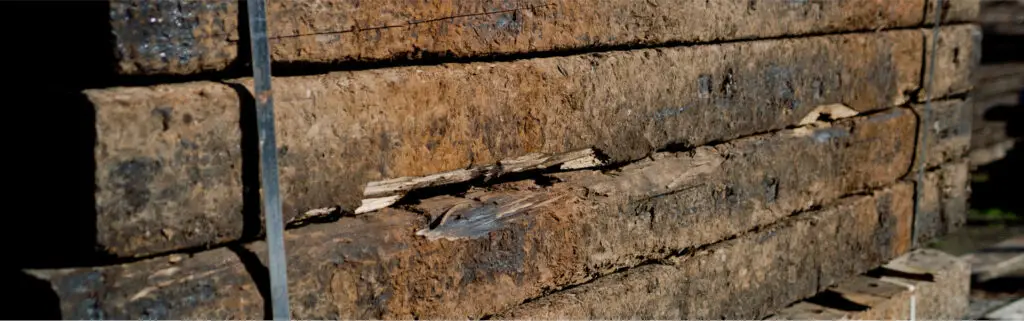
Choosing the right sleeper for your project depends on the application, the look you want, the budget, and how long you need it to last. Interlink supplies five main sleeper types to the New Zealand market — each with different strengths. Below we compare reclaimed hardwood, UK oak, NZ pine, Australian hardwood and ironwood sleepers across durability, cost, appearance, workability and best uses.
Not sure which is right for your project? Talk to Interlink — we can recommend the best option for your site and budget. Call 0508 468 375 or email info@interlinkltd.com.
Hardwood. Used hardwood railway sleepers are best – says us at Interlink Timber Solutions.
The best type of railway sleeper depends on your specific needs and preferences of course, but a hardwood will always offer richer character, a sense of history, and a practical life expectancy.
Here are some factors to consider:
Durability:
If longevity and durability are your primary concerns, concrete and steel sleepers are excellent choices but are not considered practical unless you are a national rail network. So, the better solution is a natural material, like hardwood.
Even for commercial designs and public spaces, a hardwood can offer good durability for a fraction of the price of other more robust manmade materials, and while looking much better too.
Hardwoods are also naturally resistant to bugs, pests, and moisture which can rapidly deteriorate a timber. Additional applications to a hardwood, like using a mulseal or waterproof membrane barrier when a sleeper is in damp environments or pressed against soil can be a very cost-effective yet practical consideration that will enhance the lifespan of a hardwood. — Something one would need to do even with modern, newer (softer) timbers.
The odd periodic clean of a sleeper doesn’t hurt either, removing moss and mould as well as loose dirt and grime that builds up over a decade or two. This can be easily cleaned out with a stiff broom and a hose down, while refreshing the timber’s appearance at the same time. Set to look good for another handful or two of years to come.
Aesthetics:
For landscaping and architectural projects, wooden sleepers are often preferred for their natural appearance and charm. Reclaimed hardwood sleepers offer an organic softer feel, and a timeless rustic look that will enhance any setting. Moreover, hardwood timber can be processed and modified in a very crafted and meaningful way should one be inclined; where the likes of sanding, brushing, polishing, staining, and painting are just a few easy to-do applications that can offer fantastic (visual) return to any space. Softwoods, like H4 landscape timber, or the classic NZ (Pine) railway sleepers generally do not carry this kind of capacity to be worked and adapted, nor steel and concrete. Hardwoods will always carry their natural history with them, and reflect their prior uses and history, even with a thorough clean.
Hardwood sleepers are made from a variety of timber species, depending on their source location and age.
Within New Zealand we have access to the classic Jarrah sleepers, full of lovely reddish-brown colouring, and at times their exposed grains. Additionally, there are many lighter coloured Aussie hardwoods used within the NZ rail network, as well as our historic wharf and bridge infrastructure that can use Northern Hemisphere tropical hardwoods. Often deducing a specific species once a timber is well seasoned and weathered after decades of use can be a challenge. So, working with preferred colouration and tones for a design is easier to match with availability than it is to specify a species.


Colours and finishes can typically be locked in with hardwoods using urethanes, stains, and sealants, which can also re-weather once cleaned and exposed to the local environment. Typically, one can expect different fading and weathering depending on the geographical location, where for instance, Aussie hardwood will be more prone to silver-driftwood faded weathering if in a coastal setting regardless of the species. Perhaps a more sheltered, inland setting surrounded in shade will see the weathering process occur at a varied rate with differing degrees of fade and colouring.
Environmental Impact:
If sustainability is important to you, consider using reclaimed wooden sleepers. This option reduces waste and has a lower environmental impact compared to new materials. An old rotten hardwood sleeper will have its carbon sequestered within the earth and soil, whereas a synthetic (man-made) or steel/concrete sleeper will retain its carbon for an eternity. So, creating the demand and taking up availability of reclaimed sleepers goes a long way in reducing commercial waste – and beautifying our land and city-scapes in the process.
In almost all cases, a hardwood sleeper is compatible and safe to use in any setting, for any use. In the circumstance where a sleeper is preservation treated, it is simply a matter of how and where to use it. Even though preservation treatment might be hazardous to our health (do not eat it!), it is more beneficial to use a treated sleeper in a damp or set-back environment where the treatment will slowly but surely weather off. It will also leech inwards to the heart of the timber. This drawn-out process of a treated sleeper degrading in a garden setting is much better than it going to a commercial landfill in bulk quantities, or even worse, being burnt off in huge piles at the salvage yard (offshore).
Utilising a used hardwood sleeper retains the value from the resources required to create it, and not wasted by shortening the sleeper’s life expectancy with its last 20 years spent in a landfill. Further to this, it means less manmade (treated) timber is manufactured, which still doesn’t quite do the job that a beautiful hardwood sleeper does.
Ease of Installation:
Timber sleepers, even hardwood ones, can be easily cut, modified and adapted by almost anyone. A hardwood sleeper is best lifted with two people but generally manageable on site. The key benefit to hardwood sleepers is their ongoing integrity, where once in place one can be sure of ongoing reliability. With the integrity and durability in mind, it is often most efficient to install the sleepers as robustly as the timbers are themselves. For instance, using reliable coach bolts or heavy screws should prevent any additional fixings or remedies further down the track.
Typically, with hardwood sleepers it is the case of doing things right first time to ensure ongoing steadfastness. However, one should not mistake the use of heavier materials and componentry for being heavier, harder work; rather it is planning and technique that alleviates the labour factors. Using pilot holes for fixings, a chainsaw instead of a handsaw, mulseal and polythene lining, good drainage, and an extra set of hands will mean the application will come together correctly and stay that way (hopefully) forever. This is less effort and resource than reinstating and fixing the timbers every 5–10 years.
Additionally, a hardwood sleeper can require less maintenance over the years than other newly manufactured (and preservation treated) timbers which can need seasonal cleaning and coating or even replacing.

The great thing about using hardwood sleepers is the hands-on process during the installation too. Nothing beats the feeling of selecting each sleeper to fit in its own unique space among the others. A flip and/or a spin of the sleeper can change the visual finish and perception of the application overall, knowing you (or your team) were the puzzle masters that put it all together. Uniform, newly manufactured (treated) landscape timbers just do not offer the same crafting process or visual finishes that hardwood sleepers can, nor does concrete or steel.

To conclude, hardwood railway sleepers are a versatile and durable material that can be used in various applications. Whether you’re looking for new or reclaimed sleepers (yes, unused sleepers can still be reclaimed), there are plenty of options available to suit your needs and preferences. Interlink prides ourselves on providing high-quality used hardwoods that are perfect for landscaping and architectural projects, and the fantastic results clients nationwide achieve daily. With the right installation techniques and care, these materials can last for many years, adding value, beauty and functionality to any setting – that is why hardwood railway sleepers are best.